


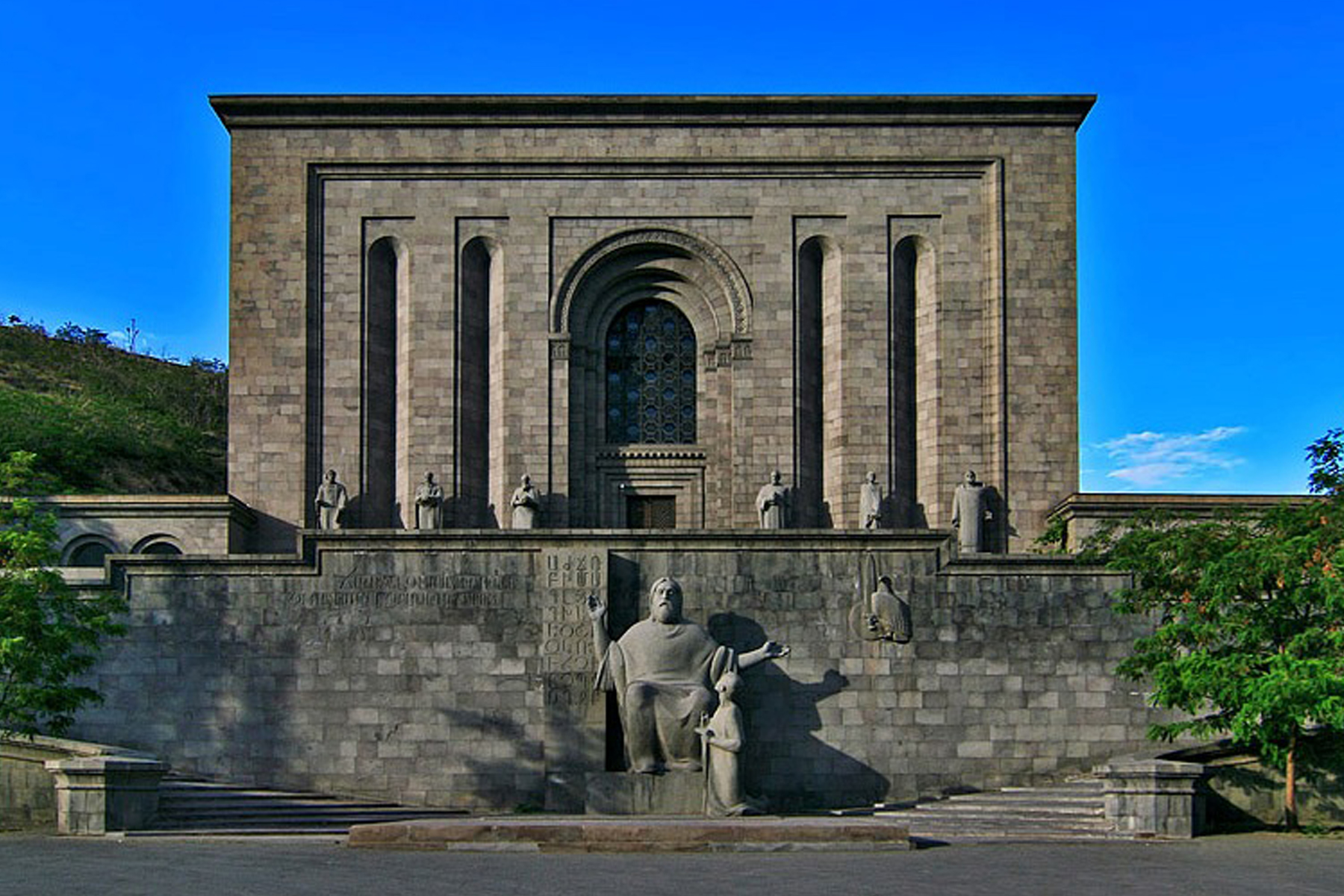
Matenadaran – The Mesrop Mashtots Institute of Ancient Manuscripts is an incredibly rare and exclusive treasure due to its collection of manuscripts and the activity that it now exercises. It holds the history of Armenian and foreign nations’ written cultures. The word “Matenadaran” means “holder of manuscripts,” or “manuscript collector”. The necessity of the existence of Matenadaran was recognized since the 5th century, when, after the creation of Armenian alphabet by Mesrop Mashtots, the first Armenian translations were made and historians began writing down the history of the Armenian people.
The Matenadaran has consolidated about 23,000 manuscripts: over 17.000 are Armenian manusripts, and 300.000 documents. These all are including almost all areas of ancient and medieval Armenian cultural and sciences – history, geography, grammar, philosophy, law, medicine, mathematics, cosmology, chronology, divination literature, translated and national literature, miniature painting, music and theater. The Matenadaran also holds manuscripts in Arabic, Persian, Greek, Ethiopian, Syrian, Latin, Tamil, and other languages. Many originals, lost in their mother languages and known only by their Armenian translations, have been saved from loss by medieval translations.
The oldest complete manuscript, that has reached us is the parchment Gospel. The Lazarian Gospel (887) is one of the unique and complete manuscripts. The largest book is the Msho Charentir: 27.5 kg, and the smallest is the Tonacuyc : 19 g.
Every year, Matenadaran has around 50,000 visitors.



Reviews
There are no reviews yet.